
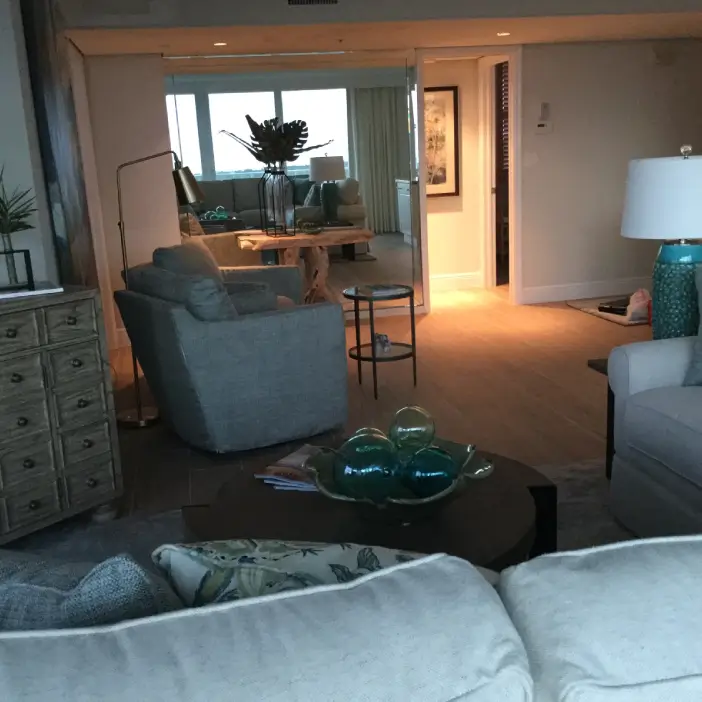
The best coastal living room ideas start with the light and the view, not the color blue. In a Southwest Florida home, the glass wall onto the lanai decides where the seating goes, the sun decides which fabrics survive, and a calm, layered palette keeps the room from reading like a beach theme. Here is how we plan it in our coastal interior design work.
Most people who ask me about a coastal living room are holding a photograph of one. It is usually lovely, and it was designed for a different house, a different view and a different kind of light. What they actually want is the feeling of the photograph, and that comes from decisions the photograph never shows.
If you want the full definition of the style first, we cover it in what is coastal interior design. This post is about the living room as a finished room, and the parts of it that change when the house is in Lee and Collier Counties.
What makes a living room coastal instead of just blue?
A living room reads as coastal when light, texture and openness do the work, not blue paint or beach objects. Natural materials, a calm palette drawn from sand and water, and furniture that leaves the view clear will do more than any theme. A generic neutral room has the palette but not the connection to the outdoors.
That connection is the difference. A generic neutral living room could be anywhere, and it is organized around the television. A coastal one is organized around where daylight comes in and what is outside the glass, and the furniture is arranged to serve both.
The test I use is simple. Stand in the doorway and ask what your eye does first. In a coastal room it should travel to the light or the view, not to a piece of decor. If the first thing you notice is an object that depicts the sea, the room is relying on a theme to do a design’s job.
Design the living room around the view and the slider wall
Here is where national coastal advice stops being useful. In most Southwest Florida homes the living room has a wall of sliding glass onto the lanai or the water, and that wall is the room’s whole reason for being. A good coastal living room design starts by protecting it.
That means the glass is not available for furniture, and the seating should face into the room with the view in sight rather than turn its back on it. I cover the placement mechanics, such as floating pieces off the walls and zoning a great room, in our open floor plan furniture layout post, so I will not repeat them here. What belongs in this post is what the glass does to the finishes.
Keep the sightline from the front door to the glass completely clear. It is the single thing that makes a living room feel larger than its plan. Keep the television off the wall that faces the glass if you can, because a screen opposite a wall of windows is a mirror for half the day.
When the sliders are open, the living room and the lanai become one space, and the finishes should feel related. We plan the two together, and the outdoor half of that conversation is in our lanai design ideas for Southwest Florida.
How do you protect a coastal living room from Florida sun?
Treat sun as a design input from the start. Choose solution-dyed or performance fabrics for any seating in direct light, layer window treatments that filter by day and close fully when needed, and keep the pieces you care most about off the afternoon path. Glare and fading are separate problems with separate fixes.
Glare is about reflection and comfort. Glossy surfaces, a lacquered coffee table or a polished stone floor bounce the light straight back at you, so matte and honed finishes tend to be kinder in a room with this much glass. Window treatments do double duty here. Something sheer filters the light through the day, and something that truly darkens the room closes for the evening or when the screen is on.
Fading is about what the sun does over time to upholstery, rugs, timber and artwork. A west-facing room takes the harshest of it. Put the most light-sensitive things on the shaded side, and be careful with art, because a favorite piece hung opposite the glass is a piece you are slowly bleaching.
Indoor-outdoor durability is the other half of living here. A Florida living room gets walked through in damp feet and sandy sandals, and performance fabrics earn their keep there. The same materials thinking runs through our coastal kitchen design ideas.
What is a modern coastal living room?
A modern coastal living room keeps the light, natural materials and calm palette of the style, then removes the cottage detail. Expect cleaner lines, simpler window treatments, fewer ornamental pieces and a few strong shapes. The risk is coldness, which texture and warm wood correct.
Modern coastal suits much of the newer housing stock here, where open plans and tall glazing already point that way. It is also where ceilings start to matter, because a plain ceiling over a spare room can feel flat. Our guide to tray ceiling ideas and coffered ceilings covers that decision, and I would plan it alongside the furniture rather than after it.
The trap in a modern coastal room is that clean lines, a pale palette and hard surfaces add up to a lobby. The cure is not more decor. It is a heavier weave on the sofa, a rug with some depth, timber with visible grain, and one piece with real presence rather than a scatter of small ones.
How do you make a coastal living room feel cozy?
Add warmth through texture, layered lighting and a darker grounding element rather than more objects. Heavier weaves, a rug with depth, warm wood and lamps at seating height make a pale room feel lived in. Cozy in a coastal room means soft and layered, not dark or crowded.
Lighting does more of this than people expect. A single overhead fixture makes any living room feel like a waiting room. Add lamps at seating height and something low and warm for the evening, and the same furniture feels completely different after dark.
Be careful about what cozy means in this climate. A heavy wool throw is lovely in a mountain cabin and miserable in a Fort Myers summer. Reach for fabrics that breathe, such as linen, washed cotton and loose weaves, and get the warmth from texture and light instead of weight.
A neutral coastal living room that holds up in strong light
A neutral coastal living room is not a single white. Florida light is strong, direct and shifting, so the same color looks different at nine in the morning and at four in the afternoon, and a palette chosen under showroom lighting often disappoints at home.
The reliable approach is to keep the undertone consistent and vary the depth. Warm whites, sand, soft greige and a muted green or blue-gray sit together happily because they share a temperature, and layering them in different tones gives the room depth without introducing a second color story. Blue works best as an accent, not the foundation.
Test before you commit. Put samples on the wall they will live on, look at them through a full day, and look at them again at night under your own lamps. Cool whites in particular can turn stark in direct sun, so they are worth checking on the brightest wall first.
Small coastal living room ideas
In a small coastal living room, commit to fewer, lighter pieces: one properly scaled sofa, two light chairs on visible legs and one large rug. Keep the view and the path to the glass clear, and let one pale, continuous color carry the walls and window treatments so the room reads larger.
Small rooms do better with a few larger pieces than a crowd of small ones, because a cluster of little tables and chairs chops up the floor and reads as clutter. In a small open plan the same principle holds, and the details are in our open floor plan furniture layout post. In a closed small room, the window is your biggest asset, so dress it simply and let the light do the work.
The living room in a seasonal home
A seasonal home is a different brief. The living room sits closed up for months, then hosts family and friends in waves, and none of the standard coastal advice accounts for that. The room has to survive being empty as well as being used, so choose fabrics and surfaces that tolerate stale, humid air, and window treatments that shield the room while nobody is there to draw them. Spend on the seating, the fabrics and the shading, and be restrained with decorative extras. We work through that kind of trade in how much it costs to furnish a house.
If you are working room by room, the same thinking applies in the coastal bathroom and coastal bedroom, and you can see how it comes together in finished rooms in our gallery.
Frequently asked questions
Do you need blue in a coastal living room?
No. Blue works best as an accent, not the foundation, and many convincing coastal rooms use very little of it. Sand, warm white, soft green and natural timber can carry the whole room. The coastal feeling comes from light, texture and openness rather than from a particular color.
Can a coastal living room have a television?
Yes, but plan where it goes before you buy anything. A screen opposite a wall of glass picks up reflections for much of the day, so it usually works better on a side wall or in a built-in, away from direct glare. Decide before drywall if the house is still being built, because the wiring follows the decision.
What flooring works in a coastal living room?
Choose flooring for the humidity and the foot traffic first, then the look. Engineered hardwood and luxury vinyl plank are often safer than solid timber in a Florida home, and large format tile is a common practical choice. A good rug then adds the softness the hard floor cannot.
Can a designer plan just the living room?
Yes, and it is a common way people start with us. A single room with a layout or finish problem is a small engagement with a large effect.
That is what our full-service interior design hourly consulting is for, and you can see how an engagement runs in our interior design process.
Let us plan the room around your view
Lisa and Miranda have spent decades designing homes across Southwest Florida, and the living room is where clients most want the coastal feeling to feel real. If yours is not working, or the house is still in framing and you want the plan settled before the walls close, call 239-980-1689 or use the contact page. You can also read about our wider residential interior design services.