
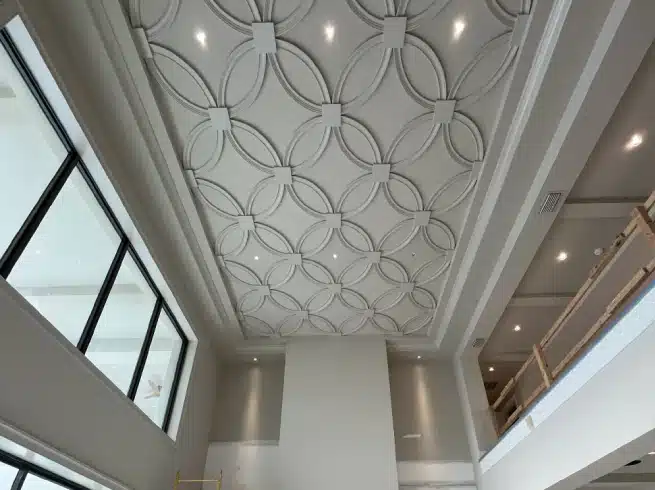
Coastal interior design is a style built on natural light, a restrained palette drawn from the shoreline, natural materials, and durability against sun, salt and humidity. It is not nautical decor. The difference matters most where people actually live near water, because here the style has to survive the climate as well as look like it. See our coastal interior design work for how that plays out in real Southwest Florida homes.
Ask what coastal interior design is and you will mostly get answers about blue and white. That is the surface of the coastal interior design style, not the substance. Living and working in Lee and Collier Counties, we design coastal homes that have to hold up to real conditions, and that reality shapes the specification list far more than any colour card does.
Here is what the style actually consists of, how it differs from the beachy look it gets confused with, and which parts of it are worth keeping in a house that sits in this climate year round.
What are the characteristics of coastal interior design?
Coastal interior design is characterised by abundant natural light, a palette of soft neutrals with restrained accents pulled from water and sand, natural materials such as linen, rattan, jute and unlacquered wood, low visual clutter, and an open flow between rooms and the outdoors. The underlying idea is calm, not theme.
Take those one at a time, because each has a practical dimension.
Light comes first. Coastal rooms are organised around where daylight enters and what it does across the day. In practice that means window treatments that filter rather than block, pale surfaces that bounce light deeper into the room, and furniture placed so it does not fight the view or the light path.
The palette is quieter than people expect. Whites, sands, soft greys, and greens, with blue as an accent rather than a foundation. The most convincing coastal rooms we have worked on use less blue than the reference photos that inspired them.
Materials carry the character. Texture does the work that pattern would do in another style. Linen, woven rattan, jute underfoot, timber with visible grain, stone with movement in it. This is where a coastal room either feels layered or feels flat.
Restraint is the luxury. In luxury coastal interior design the spend goes into fewer, better things: the quality of the upholstery, the joinery, the stone, the light fittings. Adding more objects is the fastest way to make an expensive room look cheap.
What is the difference between beachy and coastal decor?
Beachy decor is literal and referential: it uses objects that depict the beach, such as anchors, starfish, rope details, driftwood signage and shells. Coastal design is atmospheric: it evokes the shoreline through light, colour, texture and openness, without naming it. One decorates about the sea, the other feels like being near it.
This is the distinction that separates a room people want to sit in from a room that reads as a holiday rental. Nothing is wrong with a single shell that someone actually found. The problem begins when the theme becomes the design, because a theme has nowhere to go. You cannot layer it, you can only add more of it.
A useful test: remove every object that explicitly references the ocean. If the room still feels coastal, the design is doing its job. If it suddenly feels like nothing in particular, the theme was carrying it.
What is modern coastal interior design?
Modern coastal interior design keeps the light, the natural materials and the restrained palette, then strips out the cottage-style detailing. Expect cleaner lines, flatter cabinet fronts, less moulding, larger format tile and stone, and a slightly cooler, more architectural feel than traditional coastal.
It suits the newer housing stock across this region well, which is why we specify it often on new construction projects. Open plans, tall ceilings and big glazed openings are already modern-coastal in their bones, and fighting that with heavy traditional detailing rarely pays off.
The trap in modern coastal is coldness. Clean lines plus a pale palette plus hard surfaces gives you a room that photographs beautifully and feels like a lobby. Texture is the correction: a heavier weave on the upholstery, a rug with some depth, timber that has grain rather than a uniform finish.
Is coastal decor still in style?
Coastal design has stayed in favour because it is a response to a climate and a way of living, not a trend cycle. What has dated is the literal beach-theme version of it. The light-driven, material-led interpretation continues to look current because it was never chasing a moment in the first place.
The version that has moved on is the 2010s coastal-nautical look: navy and white stripes, rope accents, distressed white-painted furniture, sailboat art. What has replaced it is warmer, more textural and less saturated, with more brown and green in the mix and far less blue.
Coastal interior design ideas that hold up in a Florida house
This is where writing from Southwest Florida differs from writing about the idea of the coast.
Specify for salt air if you are near open water. Hardware, light fittings and anything metal in a home close to the water is on a shorter clock than the same item inland. This is a specification question that gets asked at the start or paid for later.
Design to the humidity, not around it. The EPA advises that indoor relative humidity should be kept below 60 percent, ideally between 30 and 50 percent. That is a design constraint as much as a mechanical one. It influences which fabrics are sensible on upholstery, whether solid timber or engineered is the safer call for a given piece, and how much you want to enclose versus ventilate.
Assume sun damage is a design input. South and west facing rooms will fade textiles and timber finishes. That is a reason to choose solution-dyed fabrics in the hardest-hit rooms, and to treat window treatments as functional equipment rather than decoration.
Let the materials list follow the climate. In practice that means quartz ahead of natural stone that can etch, engineered hardwood or luxury vinyl plank ahead of solid timber that can warp, and performance fabrics ahead of standard upholstery. The order of operations matters as much as the choices: lock the humidity-tolerant materials down before falling for a specific decorative piece, because the materials decide whether the room still looks right in five years.
Bring the outdoors in properly. The single most coastal thing about a Florida house is the relationship between the interior and the lanai. Matching or deliberately harmonising the two makes the whole house feel larger and more coherent than treating the lanai as a separate outdoor project.
Plan for a house that may sit empty. Seasonal homes need fabrics and finishes that tolerate being closed up. Furniture placement out of direct sun matters more when nobody is there to draw the shades.
Where coastal design goes wrong
The common failures are consistent enough to list, and the first one appears in the live search results as a question people are actively asking about coastal living rooms.
- Too much blue. Blue is an accent in this style, not the ground colour.
- Theme objects standing in for design. Covered above. It is the most frequent problem.
- All texture at the same scale. Rattan plus jute plus woven shades plus a loose weave
upholstery reads as busy, not layered. Vary the coarseness.
- Ignoring the light. A palette chosen under showroom lighting behaves differently in Florida
daylight, which is brighter and more directional than most people account for.
- Everything pale, nothing grounding. A coastal room needs at least one darker anchor, often
in timber, or it floats.
- Buying the reference photo. The room in the photo was designed for that house, that light and
that view. Ours is a different house.
Frequently asked questions
What is an example of coastal decor? A linen slipcovered sofa in a warm off-white, a jute rug, a timber coffee table with visible grain, woven shades filtering the light, and one or two ceramic pieces in a muted green or blue. No explicit ocean imagery, and the room still reads unmistakably coastal.
What are common mistakes to avoid when decorating a coastal living room? Over-using blue, relying on nautical objects instead of materials, choosing every texture at the same coarseness, and leaving the room without a darker grounding element. The other frequent error is treating window treatments as decoration when in this climate they are doing real work against heat and fading.
Is coastal design the same as Hamptons style? They overlap but are not the same. Hamptons style is a more formal, more traditionally detailed relative with a stronger navy and white identity. Florida coastal tends to be warmer, lighter and less formal, partly because the light and the way people live here are different.
Does coastal design work in a house that is not near the water? Yes, and it often works better when it is not literal. Away from the water the salt-air specifications relax, so the palette, light and material choices can carry the style on their own.
Can coastal design feel luxurious rather than casual? Yes, and the route to it is subtraction rather than addition. Fewer pieces, better materials, better joinery, and considered lighting. See our gallery for how that reads in finished rooms.
Start your coastal project
If you are building, renovating or refreshing a home in Fort Myers or anywhere across Lee and Collier Counties, we would like to hear what you are working with. Call 239-980-1689 or reach us through the contact page. You can also see our full range of services, or read about our approach.