
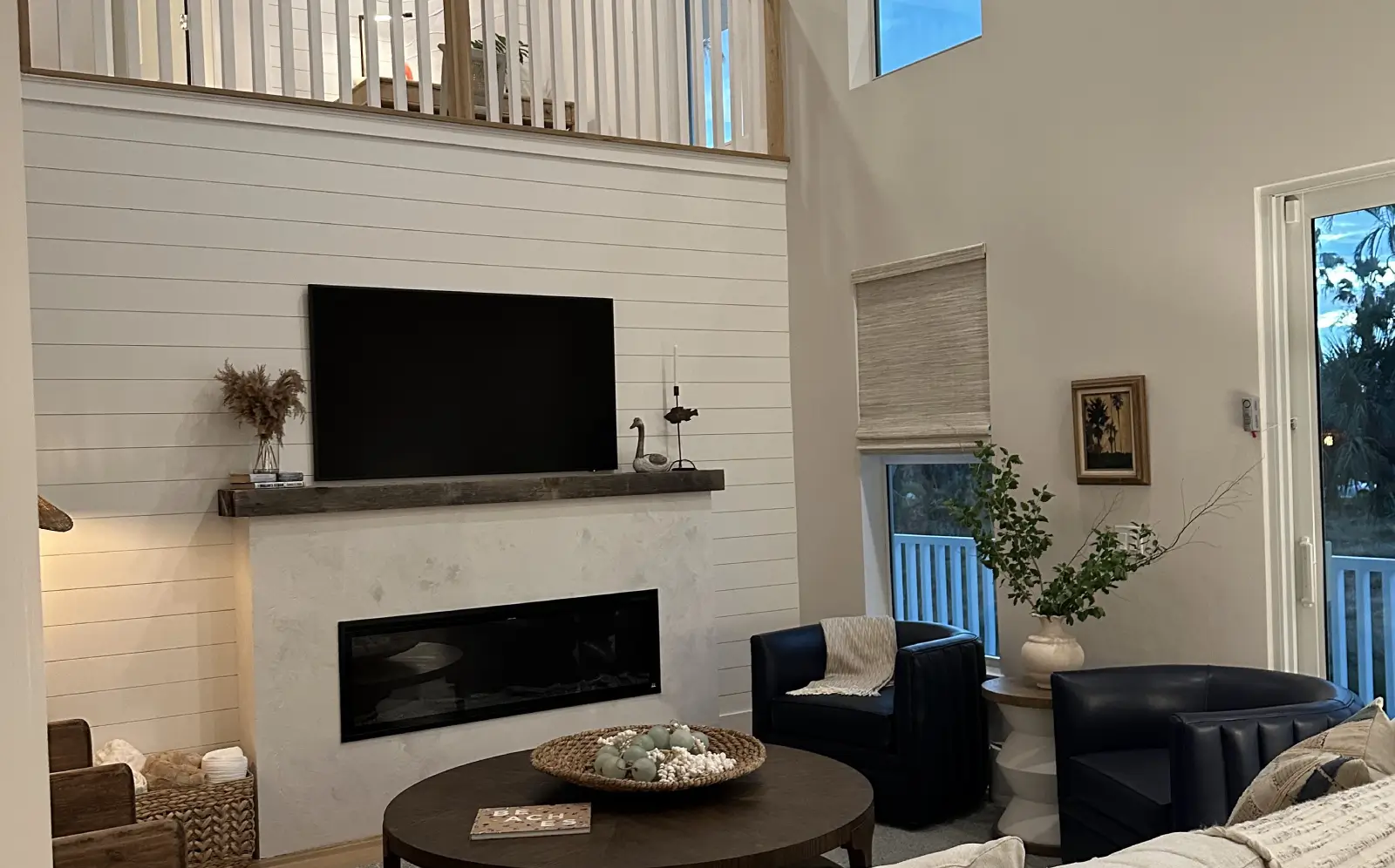
Homeowners asking how much an interior designer costs are usually asking two different questions at once: what the designer charges for their time, and what the finished room will cost. Designers bill in four common ways, hourly, flat fee, cost-plus, and a percentage of the project budget. The model you agree to matters more than the headline rate. Start with our interior design services to see which kind of engagement fits your project.
Interior design cost is the question we get before almost any other, and it deserves a straight answer rather than a brochure. The honest version is that the fee model determines what you actually pay far more than the hourly number does, and most people find that out too late. This guide walks through each model, what makes a Southwest Florida project cost more or less, and the questions worth asking before you sign anything.
We work across Lee and Collier Counties, on everything from a single room refresh to a whole house, so the range we see is wide. What follows is how designers structure fees generally, not a price list. Every project gets a written scope and a written number before work begins.
How much does it cost to hire an interior designer?
Hiring an interior designer costs either a fee for the designer’s time and expertise, or a percentage layered onto what you spend on furnishings and finishes. The designer’s fee is separate from the cost of the actual furniture, fixtures, cabinetry, and labour. Confusing those two is the single most common reason a budget conversation goes sideways.
Think of it as two buckets. Bucket one is the design fee, which buys you the plan, the specifications, the sourcing, and the project oversight. Bucket two is the spend, which is the sofa, the tile, the lighting, the window treatments, the installer’s invoice. A designer who quotes you a low fee but sources exclusively from high-end trade showrooms may cost you far more in total than one whose fee is higher and whose sourcing is disciplined.
When you ask a designer for a number, ask which bucket the number covers. If the answer is not immediate and specific, that tells you something.
How do interior designers charge? The four fee models
Interior designers charge hourly, as a fixed flat fee, on a cost-plus basis where a markup is added to goods purchased, or as a percentage of the total project budget. Some studios blend two of these, for example a flat fee for the design phase and hourly for site visits during construction.
Hourly
You pay for time at an agreed rate. This suits small, well-defined problems: a paint palette, a furniture layout for one room, a second opinion on a builder’s finish selections. It is the model our full-service design consulting is built around, for clients who want to stay hands-on and pull in professional judgement at the points where a mistake would be expensive.
The risk with hourly is open-endedness. Ask for an estimated total hours and an agreement that the designer flags it before exceeding that estimate.
Flat fee
One agreed price for a defined scope. The advantage is certainty. The thing to check is what counts as “the scope”, because revisions, added rooms, and a change of heart about the kitchen are the things that turn a flat fee into a change order. A good flat fee agreement says in writing how many revision rounds are included.
Cost-plus
The designer buys goods at trade pricing and adds an agreed markup. Handled transparently this can work well, because trade pricing on some categories is genuinely better than retail. Handled badly it is opaque. Ask directly what the markup percentage is and whether you will see the trade invoices.
Percentage of project
The fee is a set percentage of the total spend. This is more common on large new builds and gut renovations where the design work scales with the size of the job. The obvious tension is that the fee rises as the spend rises, so it works best when you and the designer have already agreed a target budget.
Interior design cost per square foot is sometimes quoted as a shorthand on very large projects, but it is a blunt instrument. A 400 square foot primary bathroom and a 400 square foot guest bedroom are not remotely the same amount of design work.
What does a first interior design consultation cost?
An initial consultation is usually either free or charged as a one off fee, and the difference tells you what the meeting is for. A free call is typically a fit-and-scope conversation. A paid consultation is usually a working session where you leave with actual recommendations you could act on yourself.
Neither is better. They are different products. What matters is knowing which one you booked, so you arrive with the right expectations and the right material. Bring photographs, rough measurements, and, if you have them, the pieces you already own and will not part with. That last category shapes a design more than most people expect.
If you are still at the stage of comparing designers rather than pricing a project, our guide to how to choose the right interior designer in Fort Myers covers what to look for before the money conversation happens at all.
What actually moves the number in Southwest Florida
Regional conditions are not a footnote here. They change specifications, and specifications change cost.
Coastal exposure. Homes near the water need finishes and hardware chosen with salt air in mind. Standard interior hardware that would last a decade inland can pit and fail far sooner near open water. That is a specification decision with a real price attached, and it is one of the things that separates a designer who works here from one who does not. Our coastal interior design work is built around exactly these choices.
Humidity. Solid wood moves, veneers can lift, and some upholstery fabrics hold moisture in a way that becomes a problem rather than a preference. The EPA advises that indoor relative humidity should be kept below 60 percent, ideally between 30 and 50 percent, and specifying to that reality is part of the job in this climate.
Seasonal occupancy. A house that sits empty for months is a different design brief from one lived in year round. Fabrics, window treatments, and even furniture placement change when a home is closed up through the summer.
Lead times. Custom upholstery and cabinetry run on their own schedules. Compressing a timeline usually means either paying for expedited production or substituting what is available, and both have a cost.
Project type. Designing alongside a builder from the ground up, as in new construction, involves different work from reworking an existing house in a renovation, where you are solving around what is already there.
Is it worth paying for an interior designer?
A designer earns their fee when they prevent expensive mistakes, not when they pick a pretty cushion. The costly errors in a project are structural and sequential: ordering the wrong quantity of tile, discovering the sofa will not fit through the stair turn, choosing finishes after the electrical is roughed in rather than before.
That last one is worth dwelling on. Lighting, outlet placement, and switch locations get locked in early in a build, and they are decided long before anyone thinks about furniture. If nobody has planned where the bed goes, the reading lights end up in the wrong place, and fixing it later means opening walls. The design fee is often smaller than the cost of one avoided rework of that kind.
The counterweight, stated plainly: on a genuinely small project with a modest furnishings budget, a full design engagement may not pay for itself. That is a reasonable moment to buy a few hours of advice rather than a full service.
Questions to ask before you sign
- Which fee model, and what is the estimated total, not just the rate?
- What exactly is in scope, and how many revision rounds are included?
- Is the fee separate from the cost of furnishings, or layered on top of it?
- If cost-plus, what is the markup and will I see trade invoices?
- Who manages the trades and installers, you or me?
- What happens to the fee if the project timeline extends?
- What credentials do you hold? The
NCIDQ examination administered by CIDQ is the profession’s recognised competency credential, and it is a fair question to ask any designer you are considering.
Frequently asked questions
How much should you budget for an interior designer? Budget for the designer’s fee and the furnishings spend as two separate lines, and settle the furnishings target first. The design fee is generally sized in relation to the scope of work, so a designer cannot give you a meaningful fee until they know roughly what you intend to spend and across how many rooms.
Is it cheaper to use an interior designer? Sometimes, on the goods, because of trade pricing, and sometimes on the project overall, because of mistakes avoided. It is rarely cheaper than doing nothing. The fair comparison is not designer versus no designer, it is designer versus the cost of the rework, returns, and compromises that tend to follow an unplanned project.
What is interior design cost per room? Per-room pricing exists but is best treated as a starting point for a conversation. Two rooms of the same size can differ by a wide margin depending on whether they need custom cabinetry, window treatments, or only furnishings and styling.
Do I pay the designer before or after the furniture? Usually a portion up front to begin the design phase, with the balance tied to milestones. Goods are typically paid for separately and often in full before they are ordered, because vendors require it.
Can I hire a designer for just one room? Yes. A single room is a normal engagement, and it is often how a longer relationship starts. Our gallery includes both single-space work and whole-home projects.
Talk to us about your project
We would rather give you a real number for your actual house than a range that fits nobody. Tell us the rooms, roughly what you have in mind, and your timeline, and we will tell you which fee model fits and what it would cost. Call 239-980-1689 or use our contact page to start the conversation. You can also read more about how we work.